Supporting Multilingual Learners Through Current Events

Updated: Jun 17

News articles can be a powerful tool for creating meaningful reading experiences in all classrooms, especially for students learning English as an additional language. However, language acquisition lessons should be intentional and well structured, and current events provide the perfect opportunity to achieve just that.
Most news articles follow a predictable format: headline, subheadline, and body text. This consistency allows teachers to create structured reading lessons while helping students feel more confident navigating informational texts. The familiar format also supports comprehension and reduces cognitive overload, allowing multilingual learners to focus on language development and content understanding at the same time.
What Is the Best Way to Structure Lessons Using News Articles for Multilingual Learners?
Select an Article
There are many important and engaging topics circulating around the world today, but it’s important to choose an article that interests either you or your students. Authentic, relevant content increases participation and engagement, which leads to deeper and more meaningful learning experiences.
When selecting an article, ensure that it is relatively short, accessible, and appropriate for your students’ language proficiency and grade level.
Engage Students With a Warm-Up
Start the lesson with an activity that activates students’ prior knowledge and gets them thinking about the topic they are about to encounter. Teachers could provide the headline and subheadline of an article and ask students to predict what the article will be about. Another engaging option is a word-sort activity, where students are given the headline, subheadline, and a list of words that may, or may not, appear in the text. Students work together to determine which words belong based on their existing knowledge of the vocabulary and topic.
Teachers may also ask students true or false questions before reading and then revisit those responses afterward to compare what students knew, or thought they knew, with what they learned from the article.
This part of the lesson is an excellent opportunity to explicitly preteach vocabulary, especially words that are meaningful and useful in students’ everyday language and academic conversations.
Practice Listening
If the lesson objective is to strengthen listening skills, teachers can read the article aloud two or three times or use a digital support feature, such as the Read to Me feature in News-O-Matic, which allows students to hear articles read aloud with natural prosody by native speakers.
Listening activities should be intensive and appropriately challenging without becoming frustrating. A few effective ideas include the following:
fill-in-the-blank activities
listening for answers to comprehension questions provided beforehand
comparing what students thought they knew before reading with what they learned while listening
These activities help multilingual learners build listening comprehension while reinforcing vocabulary and content knowledge.
Shared Reading
If the lesson objective is to improve reading comprehension or specific reading skills, it’s important to align the task with that goal. Asking higher-level questions or encouraging student-generated questions can deepen understanding and increase engagement.
Teachers might also ask students to summarize each paragraph or create an alternative headline and subheadline for the article to practice identifying the main idea.
Extension or Assessment
Students should have opportunities to practice newly acquired vocabulary and to discuss the topic with their peers. Informal debates, student-led discussions, teacher-facilitated conversations, and role-playing activities are all excellent ways to showcase new learning.
These collaborative activities help multilingual learners build confidence while strengthening academic language skills in meaningful contexts.
How Can News-O-Matic Support Multilingual Learners?
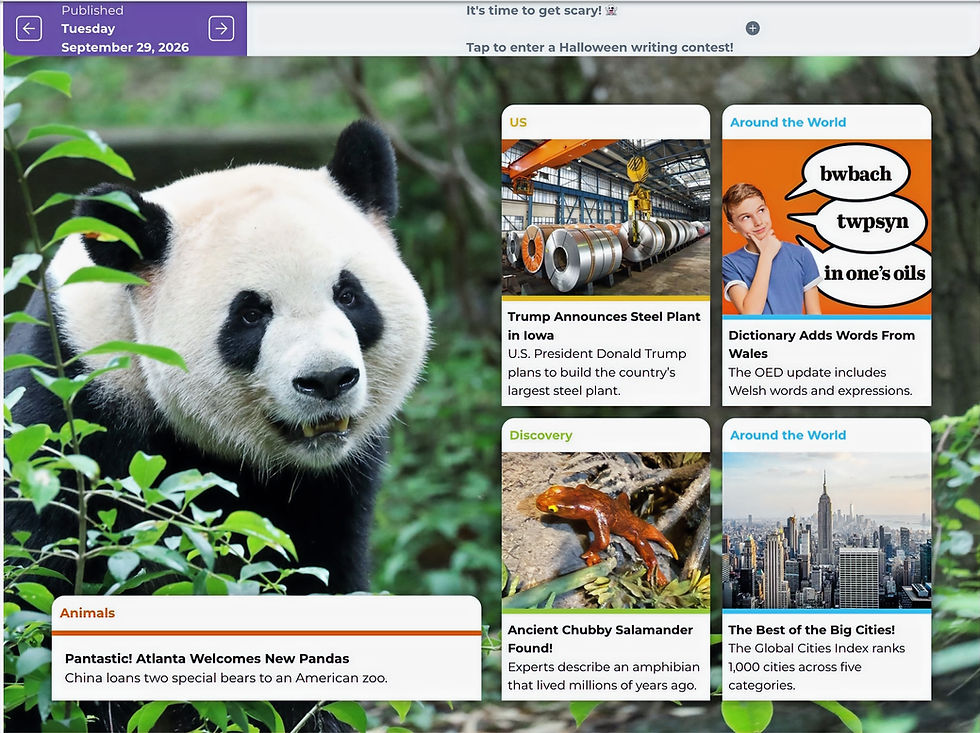
News-O-Matic articles are intentionally structured and written at accessible lengths and reading levels, making it easier for teachers to create meaningful learning experiences for multilingual learners. Every article follows a consistent format and includes visuals such as photographs, infographics, maps, and graphs to support comprehension.
The Read to Me feature encourages listening development, while differentiated questions support students at varying reading levels. Pre-selected vocabulary also reduces teacher workload and saves valuable planning time. With a wide range of engaging topics available, finding an article that connects with students’ interests is never a challenge. The hardest part is choosing just one!
Supporting multilingual learners with current events creates opportunities for authentic language acquisition, meaningful discussion, and real-world connections. When paired with predictable formats, audio support, visuals, and engaging topics, news articles can help all students access learning in ways that best support their individual needs.